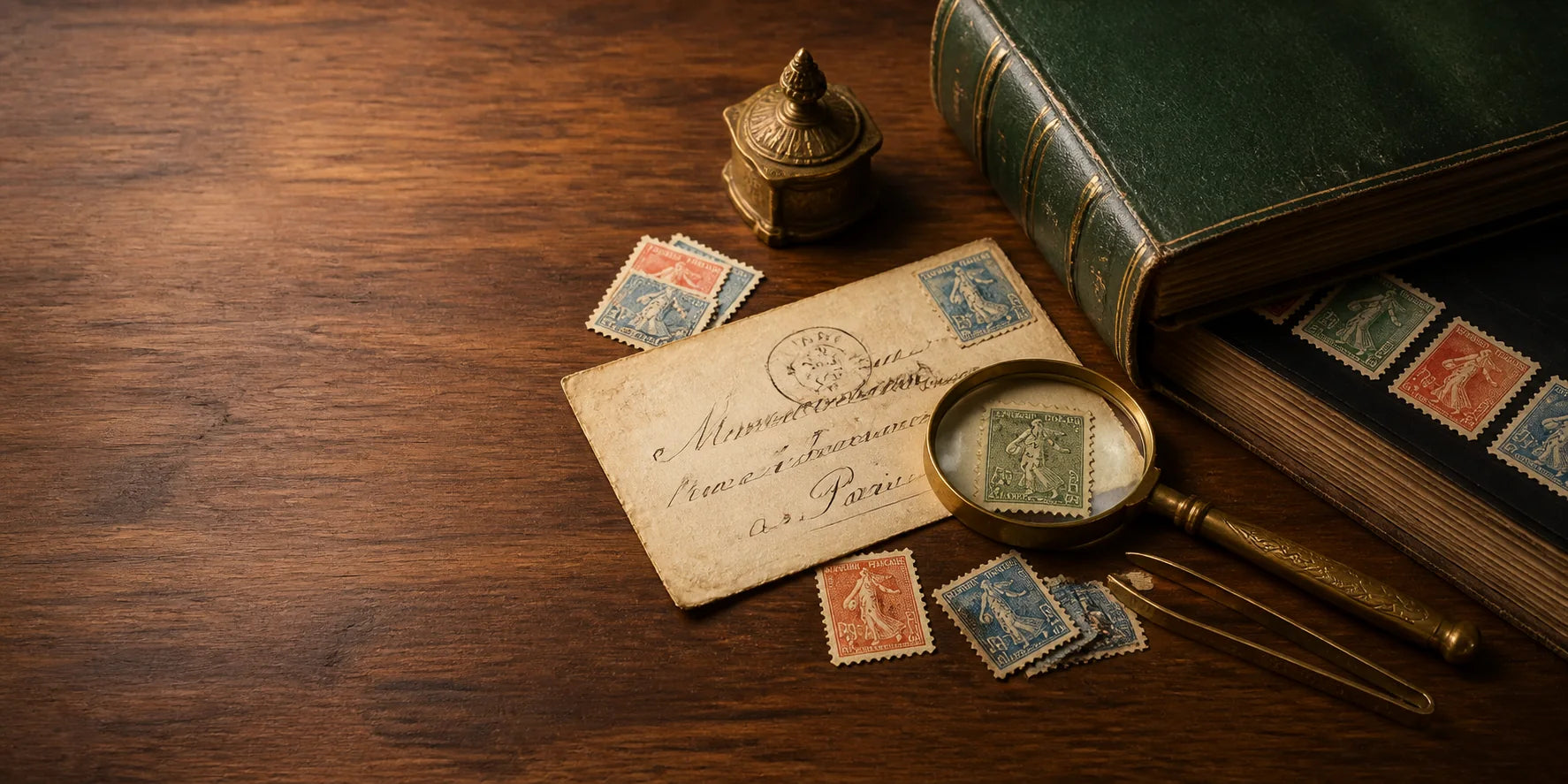
A country, a period, birds or travel: a collection becomes more personal when you know what you would like to explore. Here are a few ideas to help you find a starting point.
Faced with very different albums or a catalogue containing thousands of references, it is easy to want to look at everything at once. Choosing a focus gives your research a direction, while leaving you free to change your mind as you make discoveries.
Start with what already interests you
Ask yourself a simple question: what would you enjoy looking at, comparing and talking about? A place you feel attached to, a subject you know or a period that intrigues you can provide a starting point.
You do not need to choose a very precise subject straight away. “The stamps of a country” already gives you a direction; you can later narrow it down to a period, a series or a type of document.
Three ways to give your collection a focus
A country or territory
This approach invites you to look at the stamp issues of one territory and organise them within your chosen scope. You can begin with a limited period, rather than trying to cover its entire history from the outset.
A subject you are passionate about
Wildlife, plants, aviation, architecture, sport: a theme brings together stamps from different countries around a shared interest. To keep your collection coherent, decide what belongs within your subject and what you will leave aside.
Letters and their journeys
If you enjoy documents and traces of correspondence, antique letters can become the heart of your research. A place of origin, a destination or a period can give you a focus. Look at the document as a whole and keep the information that accompanies it.
Set a few simple boundaries
Before making lots of purchases, write down your intention in one sentence. For example: “I would like to bring together stamps depicting the birds of Europe” or “I am interested in letters connected with my town”.
Add a few practical limits: a budget you are comfortable spending on this hobby, the space you have for storage and a pace of research that suits you. Collecting should remain a pleasure; you do not have to search for every missing item.
Keep a record of your discoveries
A notebook or spreadsheet is enough to get started. Record what you actually know about each item: the country shown, the date where known, the catalogue reference if it has been identified and the information provided when you acquired it.
Keep confirmed facts separate from your assumptions. A note saying “to be identified” is better than a tentative identification later repeated as fact. Your notes will help you compare items and ask more precise questions.
Let your perspective develop
Your first idea is not a permanent commitment. As you compare items, read or talk with other enthusiasts, you may discover an aspect that interests you more.
Returning regularly to your chosen focus helps you decide what you would like to explore further. Even a small selection that you understand well can form a very personal collection.